
AI
AI in Route Optimisation
Optrak uses ML to select algorithms and tune parameters with its optimiser, using historical operational planning data to predict performance improvements — while the optimisation itself stays grounded in operations research.
Last updated: 2026-08-11
AI Optimisation
“AI” in route optimisation is not one technology but several distinct techniques. The headline use, end-to-end neural optimisation, is not yet competitive on real, constrained, production-scale problems.
Optrak’s optimisation itself is grounded in operations research — heuristics and solvers from a body of work going back decades — and machine learning selects and tunes that machinery (and will increasingly feed it better inputs) rather than replacing it.
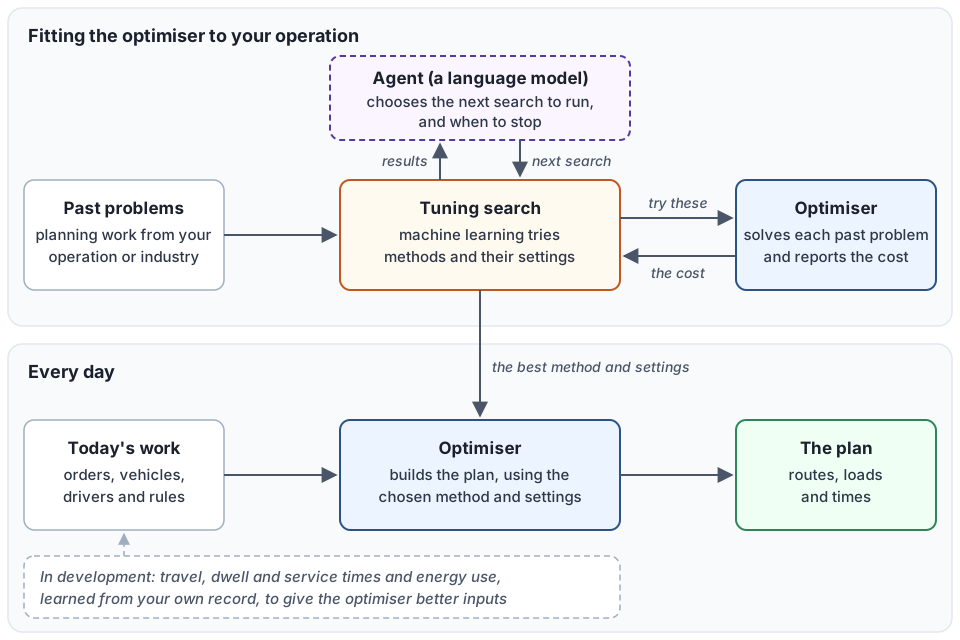
Machine learning decides how the optimiser searches; the optimiser builds the plan. No language model builds a route, works out a cost or sets a parameter value.
What to Ask When a Vendor Says “AI”
The useful question is never “do you use AI” — everyone now says yes. It is “what does the machine learning actually do, and what produces the route?” If the answer is “it selects and tunes a proven optimiser, and predicts the inputs the optimiser uses,” that is the version with production traction. If the answer is “a neural network generates the plan end to end,” ask to see it run against a real, constrained, full-size operation — not a benchmark. Where a vendor’s “AI” means the optimiser has been replaced by a neural network, it will not yet match well-engineered traditional optimisation on production-scale problems with many constraints.
Read On
- Uses of AI in vehicle routing — the five distinct things “AI” can mean here, and where Optrak stands on each
- Strategic uses of AI — the operational record as an asset, and AI as a strategic assistant
- Analytics and strategic planning — the record of every plan you run, and testing a decision before you make it
Frequently Asked Questions
Is Optrak’s optimisation “AI”?
Parts of it. Optrak uses machine learning to select algorithms and tune parameters, with an LLM agent orchestrating the tuning. The route plans themselves are produced by operations-research optimisation, not by a neural network.
How does Optrak AI use my data?
Optrak uses AI elements to design an optimisation, which then runs against a large portfolio of real historical routing problems in relation to a particular operator or industry. The results of each run are evaluated in terms of their “cost”, and reported back to the AI designer to assess its performance. Specific data such as customer names or location, or order details are never seen by the AI component.
Do you use a neural network or an LLM to plan routes?
No. No neural network generates routes, and no language model produces a route, evaluates a cost, or sets a parameter value. The LLM acts only as an orchestration agent over the tuning search.
Why not use end-to-end neural optimisation if it’s the future?
Because today it does not match well-engineered traditional optimisation on production-scale problems with many constraints. It is an active research area worth watching, but not a sound basis for a live planning operation. Optrak’s architecture keeps it swappable if and when that changes.
How does machine learning improve the plans I get?
Today, by fitting the optimiser to your operation (algorithm selection and parameter tuning). A second route is in active development: learning better inputs — travel, dwell, service times, and energy use — from your own operational record, so feasibility and cost are estimated more accurately.
See Optrak on Your Own Routes
Book a demo and we'll model your fleet, depots and constraints — and show the savings on real data.