What Optrak does
What Is Vehicle Routing?
Optrak builds your daily delivery and collection routes automatically — deciding which vehicle does which drops, in what order — against real driver shifts, vehicle limits, customer time windows, and journey times that change through the day.
Last updated: 2026-08-11
Every distribution operation faces the same question each day: given the deliveries and collections that have to happen, the vehicles in the yard, and the drivers rostered on, who does what, and in what order? Do it well and the work gets done with fewer miles, fewer vehicles, and no broken promises to customers. Do it by hand on a whiteboard and you leave time, fuel, and capacity on the table — and you can’t easily see what a better plan would have looked like.
Optrak builds those plans for you. You give it the day’s work and the rules it has to keep to, and it decides the vehicle-by-vehicle routes that get everything done at the lowest cost — then hands the drivers a sequence they can actually run.
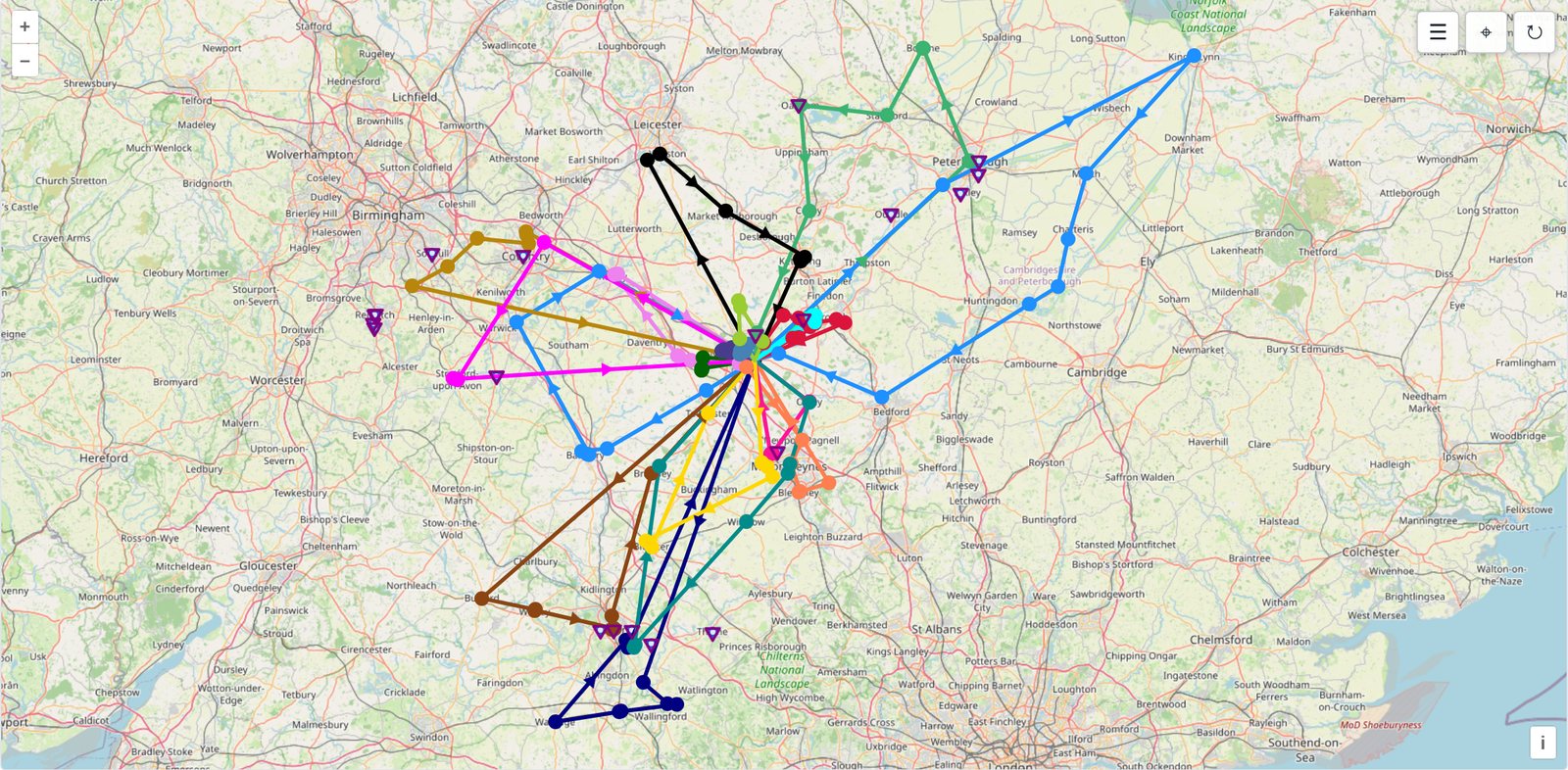
One day’s plan from a depot in Northampton: 21 journeys, one colour each. Map data © OpenStreetMap contributors.
The Rules a Plan Has to Keep
A route that looks efficient on a map is worthless if it breaks in the yard or on the road. A usable plan has to respect all of the following at once:
- What each vehicle can carry — weight and volume, and where the operation needs it, separate compartments and temperature zones.
- When customers will take a delivery — time windows, booking slots, and site access restrictions.
- What drivers are allowed to do — shift lengths, legally required breaks, and which drivers are signed off for which vehicles or loads.
- How long the roads actually take — journey times that rise and fall through the day, not a single average.
Hold one of these and ignore the rest and you get a plan that has to be fixed by hand every morning. Optrak’s job is to hold all of them together.
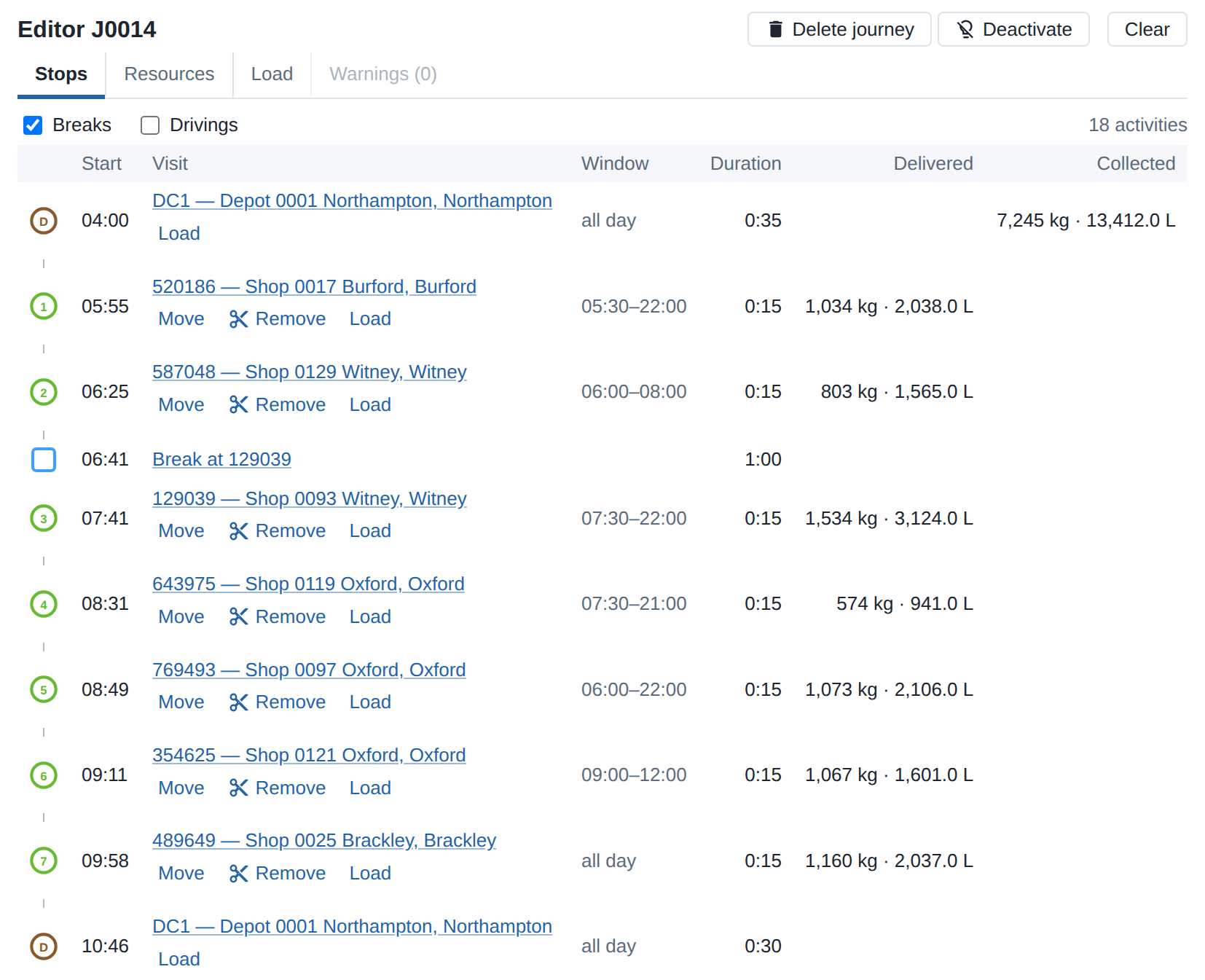
One journey’s stops in the order they are planned, with the time each delivery starts and the window the shop takes deliveries in. Two windows are narrow, 06:00–08:00 and 09:00–12:00. The driver’s hour’s break comes before the third shop, which doesn’t take deliveries until 07:30.
Planning Against the Real Road
A plan is only as honest as its travel times. Optrak plans against time-varying journey times, so the same stretch of road counts for more in the morning peak than it does at midday. That is what stops a tidy-looking schedule from quietly running an hour late by mid-afternoon, and it is why the arrival times Optrak gives a customer are ones you can stand behind.
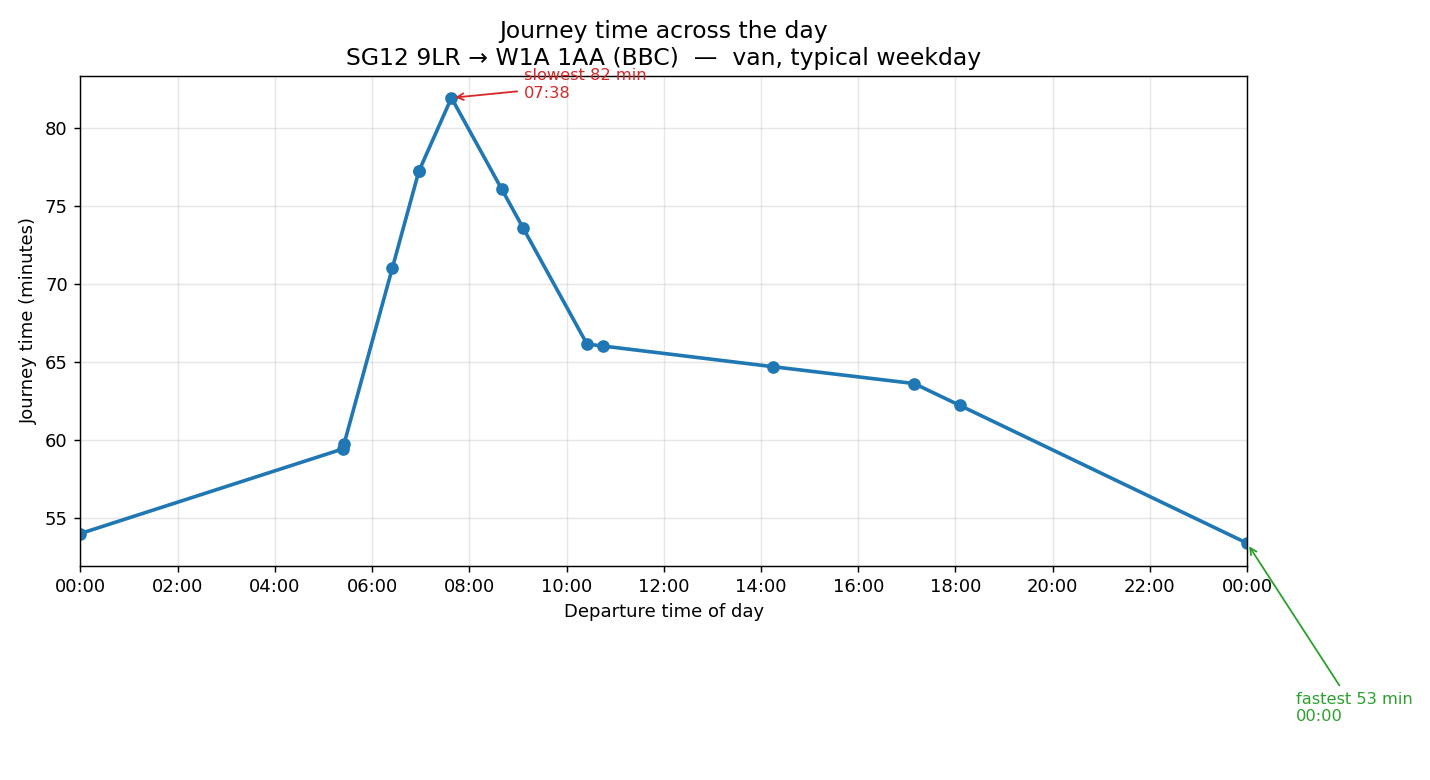
The same van trip, by the time it sets off: 82 minutes leaving at 07:38, against 53 overnight.
One Plan, All the Rules at Once
Underneath, Optrak’s optimisation engine searches a very large number of possible plans and keeps the best one it can find inside the time you give it. It weighs every constraint together rather than in stages, because fixing the vehicles first and the sequence second — the way a person has to — misses the plans where a different split of the work would have been cheaper.
It also fits itself to your operation. Rather than shipping one generic setting, Optrak tunes the search to the kind of work you actually run — many small drops or a few big ones, tight windows or loose, one depot or several — so the plans suit your day rather than an average of everyone’s.
Built on a Model of Your Operation
None of this works on a generic delivery problem. Optrak treats your sites, orders, vehicles, and drivers as real things with real properties — a depot with opening hours, a customer that needs a tail-lift, a driver break mid-shift — so the plan reflects your operation rather than a simplified sketch of it. That is the difference between a number in a sales deck and a plan the transport office can run tomorrow.
Related
- The optimisation engine — how Optrak searches for the best plan
- How the optimisation works — the method in plain terms
- The Optrak data model — sites, orders, vehicles, and drivers as first-class inputs
- Congestion and journey times — planning against the road as it really is
- Fleet and resources — vehicles, drivers, and equipment
Frequently Asked Questions
How is this different from a sat-nav or a Google Maps route?
A sat-nav finds the quickest way between stops you have already chosen and put in order. Route planning does the harder job first: deciding which vehicle should do which drops, and in what sequence, across your whole day’s work — while respecting vehicle capacity, driver hours, customer time windows, and access restrictions. The driving directions come after that decision, not instead of it.
Can it handle time windows, driver hours, and vehicle restrictions together?
Yes — that is the point of it. Real plans are constrained on several fronts at once: a customer who only takes deliveries before 10am, a driver who is out of hours at 2pm, a vehicle that can’t reach a particular yard. Optrak’s optimiser weighs all of those at the same time rather than fixing one and hoping the rest still hold.
Does the plan reflect real traffic, or straight-line distances?
Real journey times. Optrak plans against time-varying journey times so a leg that takes 20 minutes at 6am and 50 minutes in the rush hour is treated as two different things. A plan built on averages looks fine on paper and then runs late where it matters.
How much of my operation do I have to describe before it is useful?
The routing is only as good as the model behind it, so Optrak takes your real sites, vehicles, drivers, and orders as first-class inputs rather than rounding them to a generic delivery problem. In practice that means the plan reflects how your operation actually runs — which is what makes the savings real rather than theoretical.
See Optrak on Your Own Routes
Book a demo and we'll model your fleet, depots and constraints — and show the savings on real data.