Industry
Lubricants Distribution
Optrak plans lubricants distribution — compartmented tankers carrying many grades with cleaning costed by product family, and hybrid trucks whose floor space carries pumped IBCs alongside drums and palletised packaged goods — proven in a nationwide operation at Fuchs Lubricants (UK).
Last updated: 2026-08-14
Lubricants distribution is bulk multi-compartment work taken to its extreme. The contamination discipline is the same as for fuels — a compartment holds residue of its last product, so every change of grade has a cleaning cost — but it applies across many more grades, delivered in smaller quantities, to customers who take some products pumped and others packaged. Bulk multi-compartment distribution covers the ground the two trades share: cleaning matrices, pump sequencing, driver qualifications, and the multi-day order book. This page is about what lubricants add.
Many Grades on One Tanker
The tanker side of lubricants runs like fuels, with one difference of scale: many grades, pumped off at different rates. With that many products a grade-by-grade cleaning matrix would be unmanageable, so Optrak’s bulk load optimisation costs transitions by product family — grades within a family follow one rule, and the matrix stays maintainable as the range grows. The rest of the machinery is shared with fuels: permanent product-to-compartment rules, metered and unmetered compartments, and pump sequencing, all checked inside the route optimiser on every candidate move, so a plan that would contaminate a compartment or a pump is never produced.
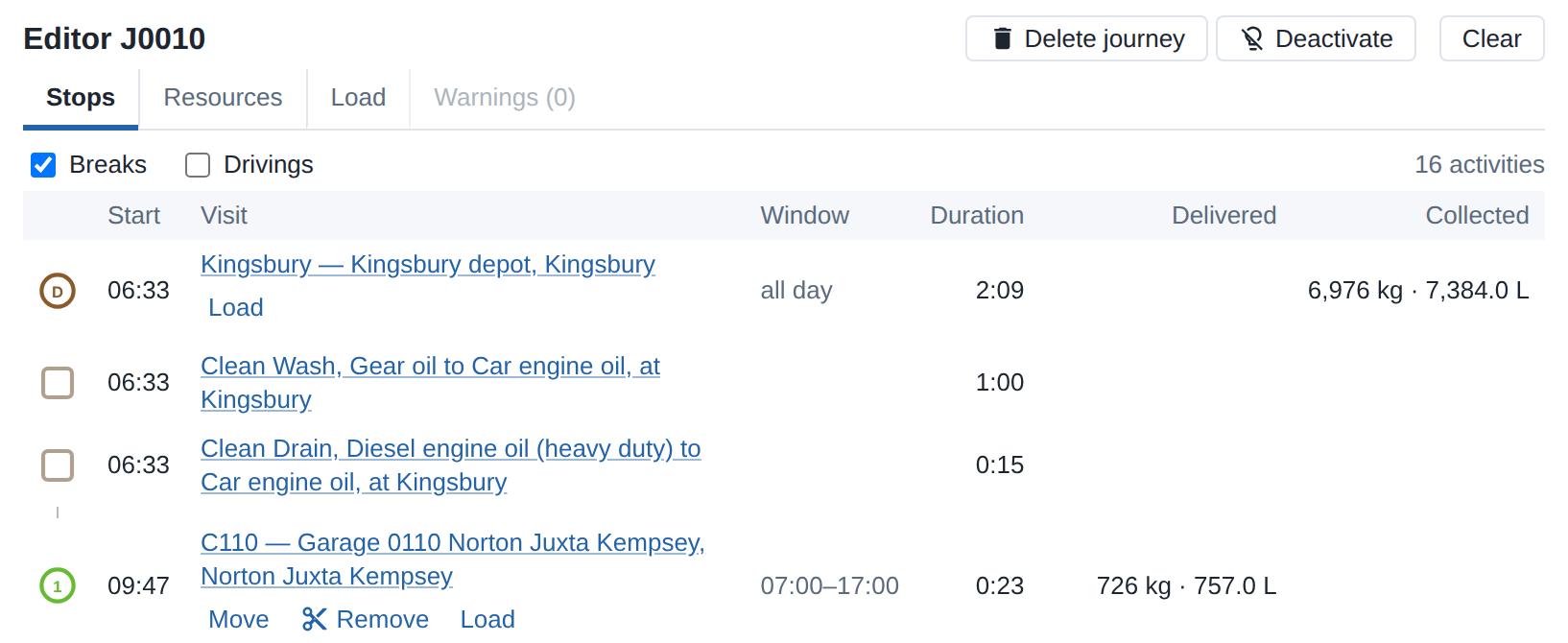
The cleans are part of the plan. This tanker’s day starts with a wash and a drain at the depot, because two of its compartments still hold a trace of yesterday’s product.
The Hybrid Truck
Not every lubricants customer takes a tanker. Smaller deliveries go out packaged — drums, and cartons on pallets — and in between sits the intermediate bulk container (IBC): a tank of around a thousand litres on a pallet-sized footprint.
The hybrid truck serves all of this from one vehicle. It is a box truck fitted with pumping equipment, loaded with IBCs that are pumped off at the customer’s site — and the same floor space can carry drums or palletised packaged goods instead. What the vehicle can do on a given day depends on what is on the deck: more IBCs means more pumped deliveries and less room for packaged work, and the right split changes from one trip to the next.
For planning, this is capacity that is not a single number — the same situation as a moveable-bulkhead trailer in multi-temperature work. The load — IBCs, drums, pallets — competes for one floor, checked by the loader while the route is built; orders that need pumped delivery can only go on a vehicle with pumping equipment; and the bulk-against-packaged split on each trip is an outcome of the optimisation rather than a fixed property of the truck.
Optrak in Practice: Fuchs Lubricants
Fuchs Lubricants (UK), part of the world’s largest independent lubricants company, runs a nationwide fleet of tankers with up to three pumps and nine compartments, carrying many grades pumped off at different rates. The compartment-and-pump rules that prevent contamination were previously managed by hand — slow, and one error risked contaminating a load.
Optrak automated the route and load planning end to end, interfaced to SAP, with the cleaning matrix and pumping order maintained automatically. Benchmarked outcomes included planning time cut by over 85%, tanker capacity utilisation up 6%, a rise in “no action” loads where a grade can be pumped into a compartment with no preparation, and the most costly wash-out-and-clean actions down 13% — alongside the company’s best-ever on-time delivery performance and a lower pence-per-litre delivery cost.
Related
- Bulk multi-compartment distribution — cleaning matrices, pump sequencing, terminals, and the multi-day order book
- Load optimisation — the bulk loader and the 2D floor-plan loader in detail
- Fleet and resources — drivers, vehicles, and qualification rules
- The Optrak data model — how loading, resources, and orders feed one optimiser
Frequently Asked Questions
What makes lubricants distribution different from fuel distribution?
Scale of range and mix of delivery. A lubricants operation carries many more grades than a fuel one, so contamination rules are managed by product family rather than product by product. And not every delivery is a tanker delivery: the same customer base takes bulk product pumped off, IBCs, drums, and palletised packaged goods — sometimes from the same vehicle on the same round.
What is a hybrid lubricants truck?
A box truck fitted with pumping equipment. It carries intermediate bulk containers (IBCs) — tanks of around a thousand litres on a pallet-sized footprint — and pumps product off at the customer’s site; the same floor space can instead carry drums or palletised packaged goods. One vehicle covers pumped and packaged deliveries, and the split between them changes from trip to trip.
How does Optrak plan a hybrid truck?
As floor space that everything on the vehicle competes for. IBCs, drums, and pallets are placed by the loader while the route is built, so a trip whose load doesn’t fit is rejected before it reaches the plan. Orders that need pumped delivery go only on a vehicle with pumping equipment, and the bulk-against-packaged split on each trip is an outcome of the optimisation, not a fixed property of the truck.
Why is the cleaning matrix organised by product family?
With many grades, a grade-by-grade matrix of cleaning rules would be too large to maintain and too easy to get wrong. Grouping grades into families gives one rule per family pair — drain, flush, wash, or no action — so the matrix stays maintainable as the product range grows. The detail is on the load optimisation page.
See Optrak on Your Own Routes
Book a demo and we'll model your fleet, depots and constraints — and show the savings on real data.